Robotic hip replacement surgery (DAA)
Replacing a worn hip through the DAA, with robotic assistance to position the new ball and socket — muscle-sparing surgery for long-standing groin and hip pain.
Also called: DAA hip replacement · DAA · Robotic-assisted total hip replacement · THR · Hip arthroplasty
What robotic hip replacement (daa) is
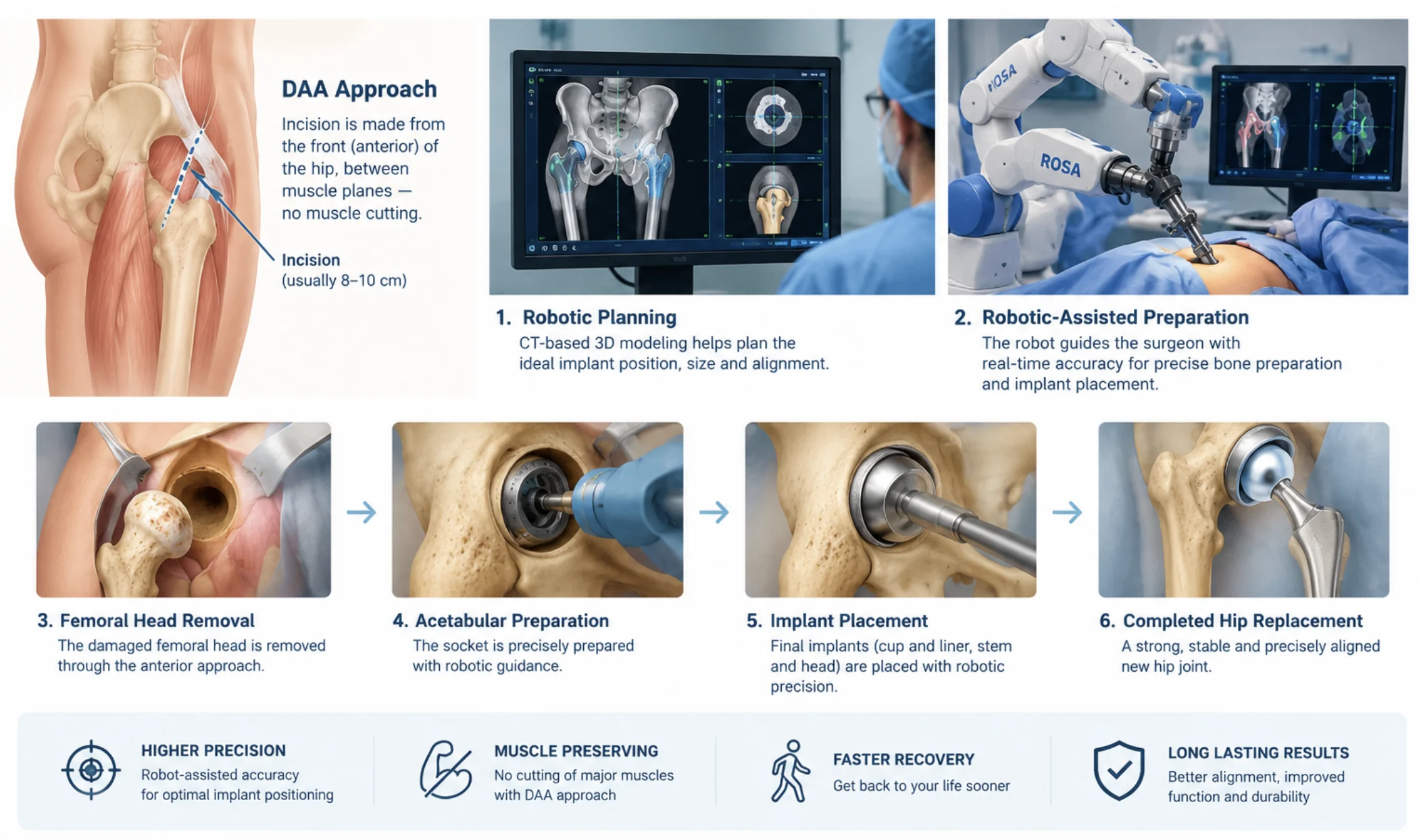
The hip is a ball-and-socket joint. In a hip replacement, the worn ball at the top of the thigh bone is removed and replaced with a smooth implant, and the socket in the pelvis is resurfaced with a matching cup.
It is done for advanced arthritis, for avascular necrosis (where the blood supply to the ball of the hip fails and the bone collapses), and sometimes after certain hip fractures. Patients often describe the result as the most dramatic relief of the joint replacement operations.
The DAA (DAA) reaches the hip from the front, between the muscles rather than through them. No muscle is cut or detached, which is why patients typically walk sooner, need fewer precautions about positions to avoid, and have a lower risk of dislocation than with approaches from the side or back.
Robotic assistance adds precision to that: the position of the socket and the length of the leg are planned on your own scan and the robotic arm guides the surgeon to that plan in theatre, so the new joint sits where it should and the two legs finish the same length.
Who needs it
These are the signs that usually bring someone to a consultation about this. Having one of them does not mean you need the procedure — it means it is worth assessing.
- Deep groin or buttock pain that limits walking, and often pain referred to the thigh or knee
- Difficulty with socks, shoes, and getting in and out of a vehicle
- Stiffness that makes the leg feel shorter or turned out
- X-rays or MRI showing advanced arthritis or avascular necrosis
- Pain that persists despite medication, physiotherapy, and activity changes
What is usually tried first
Early hip arthritis and early avascular necrosis are sometimes managed without replacement, particularly in younger patients.
- Physiotherapy to maintain hip movement and strengthen surrounding muscles
- Weight management and use of a stick in the opposite hand
- Medication for pain and inflammation
- In early avascular necrosis, joint-preserving procedures may be considered
How it is done at Poona Orthopaedic Clinic
Hip replacement is offered after examination and X-rays confirm that the joint, rather than the back or the soft tissues around the hip, is the source of the pain, and once non-surgical measures have been tried. At Poona Orthopaedic Clinic hip replacements are done by the DAA with robotic assistance, at an affiliated hospital in Pune: a muscle-sparing route into the joint, and an implant positioned to a plan made on your own scan. Patients are up and walking with support within a day, and because no muscle is detached the list of positions to avoid is short — it is explained before, not after, the operation.
- Careful diagnosis first — true hip pain is felt in the groin, and back problems are ruled out
- DAA: through the front of the hip, between the muscles, with none cut or detached
- Robotic assistance for socket position and leg length, planned on your own scan
- Surgery at an affiliated hospital; implant choice is discussed with the patient beforehand
- Early mobilisation with a walker, with fewer restrictions than older approaches
- Follow-up reviews at the clinic in Kondhwa
Recovery, honestly
Timelines vary between patients. This is the usual shape of recovery rather than a promise about your own.
Day 0–1
Standing and walking a few steps with a walker usually begins within a day of surgery.
In hospital
A short stay covering pain control, wound care, and learning the movements to avoid in the early weeks.
Weeks 1–6
Walking distance builds steadily. Most patients move from walker to stick, and many are walking unaided by the end of this period.
Weeks 6–12
Normal household and outdoor activity generally returns. Your surgeon will tell you when it is safe to drive and to travel.
3–12 months
Muscle strength and endurance keep improving; most people stop thinking about the hip during everyday life.
Questions patients ask
It is the route the surgeon takes into the hip: from the front, between the muscles, rather than from the side or back through them. Because no muscle is cut or detached, most patients walk sooner, have fewer restrictions on how they sit and lie, and a lower risk of the new hip dislocating. Combined with robotic planning of the socket position and leg length, it is how hip replacements are done at this practice.
Most modern hip implants last 20 years or more. Longevity depends on age, weight, activity, and bone quality.
Depending on the surgical approach used, you may be asked to avoid bending the hip past 90 degrees, crossing your legs, or twisting on the leg for the first several weeks. Your surgeon will give you the specific precautions that apply to your operation.
These positions put the hip into the exact ranges that carry the highest risk of dislocation, so they are usually discouraged, especially in the early months. Many patients arrange a raised toilet seat before surgery. Discuss your home setup with your surgeon beforehand.
Yes. Caught early, before the bone collapses, avascular necrosis may be treatable with procedures that aim to preserve the joint. Once the ball of the hip has collapsed, replacement is usually the reliable option.
Short local journeys are usually fine within a few weeks. For long flights or train journeys, ask your surgeon — the main concern is the risk of blood clots from sitting still for long periods.
What patients say
Experiences with robotic hip replacement (daa) live on the clinic’s Google profile, exactly as patients wrote them — we link to reviews rather than curating them here.
Related symptoms
Related treatments
Joint injections
Targeted injections used to settle inflammation and pain in a specific joint or tendon, usually to make rehabilitation possible.
Read more
Non-surgical arthritis care
A structured plan to control arthritis pain and keep you active — for the many patients who do not need surgery, or who are not ready for it.
Read moreConsidering robotic hip replacement (daa)?
Bring your X-rays or MRI if you have them. A consultation should leave you clear about what is wrong, what the options are, and what happens if you wait.