Robotic knee replacement surgery
Resurfacing a knee worn down by arthritis, with robotic assistance to place the implant exactly to plan — less pain after surgery, a faster recovery, and a knee that lets walking, stairs and sleep stop hurting.
Also called: Robotic-assisted total knee replacement · Total knee replacement · TKR · Knee arthroplasty
What robotic knee replacement is
A knee replacement removes the worn surfaces of the knee joint and replaces them with an implant, usually a metal cap on the thigh bone and shin bone with a smooth plastic bearing in between. The knee is resurfaced rather than removed — the ligaments and muscles that move it stay in place.
It is most often done for advanced osteoarthritis, when the cartilage that cushions the joint has worn away and bone is rubbing on bone. The aim is straightforward: to take away the pain and let you walk reasonable distances again.
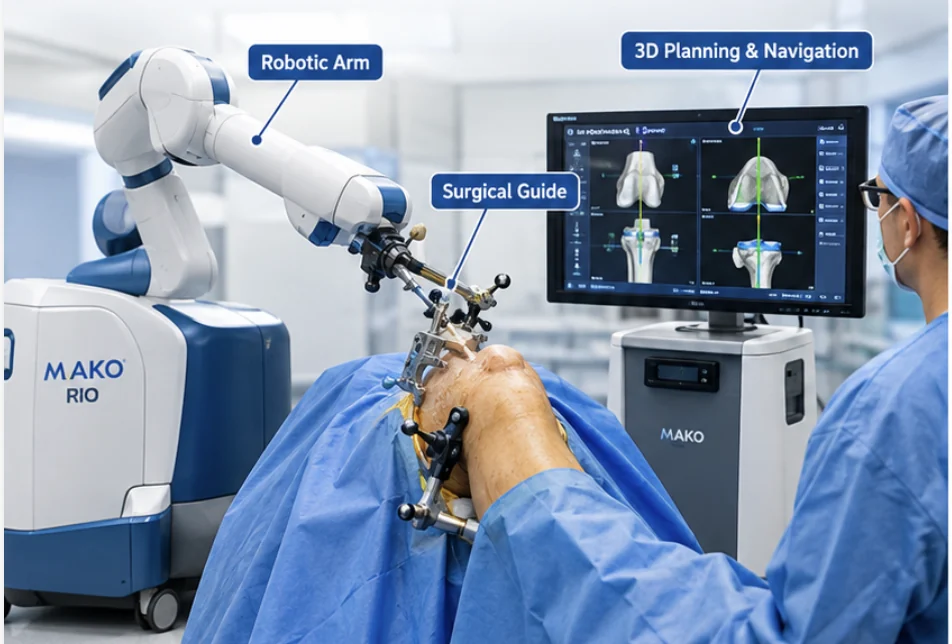
In a robotic-assisted knee replacement, a scan of your own knee is used to plan the size and position of the implant before the operation. In theatre, a robotic arm guides the surgeon’s instruments so that the bone cuts follow that plan to within a millimetre. The surgeon still performs the operation; the robot makes the cuts more precise and the implant better balanced, which is what patients feel as a knee that moves naturally.
Why robotic assistance matters
A robotic-assisted knee replacement is the same operation done with more information and more precision. The differences patients notice come from four things:
Pre-operative planning
A CT scan of your own knee is turned into a 3D model, and the implant size, position and alignment are planned on it before the day of surgery — rather than judged by eye in theatre.
Accurate implant placement
In theatre the robotic arm keeps the saw within the planned boundaries, so the cuts and the implant position match the plan to within a millimetre. Accurate alignment is what lets a new knee feel natural and wear evenly.
Less cutting of healthy tissue
Because the cuts are planned and guided, less bone is removed and the ligaments and soft tissues around the knee are disturbed less than in a conventional operation.
Less pain, faster recovery
Less soft-tissue disturbance and a well-balanced joint typically mean less swelling and pain in the first days and weeks, an easier start to physiotherapy, and an earlier return to walking, stairs and everyday life. Recovery still depends on the work you put in.
Who needs it
These are the signs that usually bring someone to a consultation about this. Having one of them does not mean you need the procedure — it means it is worth assessing.
- Knee pain that limits everyday walking, stairs, or standing, and no longer settles with rest
- Pain that wakes you at night or is present when you are sitting still
- X-rays showing advanced arthritis with loss of joint space
- Progressive bowing or deformity of the leg
- Little or no lasting relief from physiotherapy, weight management, medication, or injections
What is usually tried first
Knee replacement is not the first step. Most patients are offered a period of non-surgical treatment, and many do well enough on it that surgery can be deferred for years.
- Physiotherapy focused on quadriceps and hip strength
- Weight management, which reduces the load through the knee with every step
- Activity modification and, where useful, a walking aid
- Pain relief medication, used sensibly and reviewed regularly
- Joint injections in selected cases
How it is done at Poona Orthopaedic Clinic
At Poona Orthopaedic Clinic the decision to replace a knee is made together with the patient, after an examination and X-rays, and only once non-surgical treatment has had a fair trial. Knee replacements are done as robotic-assisted procedures at an affiliated hospital in Pune: the implant is planned on your own scan and placed with robotic guidance, for precise alignment and a well-balanced knee. Walking with support begins the day after surgery, and physiotherapy is planned before admission so that nobody goes home without knowing what the next six weeks look like.
- A consultation first: examination, X-rays, and a plain discussion of alternatives and timing
- Robotic-assisted surgery at an affiliated hospital — the implant planned on your scan and placed with robotic guidance
- Standing and walking with a walker from the day after surgery, and a physiotherapy plan set out before admission
- Follow-up at the clinic in Kondhwa, with stitches, wound checks and progress reviews close to home
Recovery, honestly
Timelines vary between patients. This is the usual shape of recovery rather than a promise about your own.
Day 0–1
Most patients are helped to stand and take a few steps with a walker on the day of surgery or the morning after.
In hospital
A stay of a few days is typical, focused on pain control, wound care, and getting you walking safely.
Weeks 1–6
Home physiotherapy, gradually increasing walking distance, and working on bending the knee. Most people move from a walker to a stick during this period.
Weeks 6–12
Everyday activities — household work, walking outdoors, stairs — usually become comfortable. Driving is generally possible once you can control the car safely and are off strong painkillers.
3–12 months
Strength and stamina continue to improve. The final result of a knee replacement is usually judged at about a year.
Questions patients ask
The surgeon still does the operation. A scan of your knee is used to plan the implant size and position beforehand, and in theatre a robotic arm guides the instruments so the bone cuts follow that plan precisely. The benefit is accuracy — alignment and soft-tissue balance to within a millimetre — rather than a different implant or a smaller cut.
Modern knee implants commonly last 15–20 years or more. How long yours lasts depends on your weight, activity level, bone quality, and how well the implant is positioned. Younger and heavier patients tend to wear implants faster.
Most surgeons advise against deep squatting and sitting cross-legged on the floor after a knee replacement, because those positions load the implant heavily. Many patients regain enough bend to manage them occasionally, but they are not recommended as everyday habits. This is worth discussing openly before surgery if floor sitting matters to you.
The first few days are uncomfortable, but pain control has improved a great deal. Most patients are surprised that they can stand and walk within a day. Pain during physiotherapy is normal in the early weeks and settles steadily.
Sometimes, yes. Doing both together means one anaesthetic and one recovery, but it is a bigger physical demand, so it is only offered to patients who are otherwise fit. Your surgeon will advise based on your general health.
Stairs usually start within the first couple of weeks with support. Desk-based work is often possible by around six weeks; work that involves standing, travelling, or physical labour takes longer.
Serious complications are uncommon but real, and include infection, blood clots, stiffness, and implant loosening over time. Your surgeon should go through the specific risks in your case, along with what is done to reduce each of them.
What patients say
Experiences with robotic knee replacement live on the clinic’s Google profile, exactly as patients wrote them — we link to reviews rather than curating them here.
Related symptoms
Related treatments
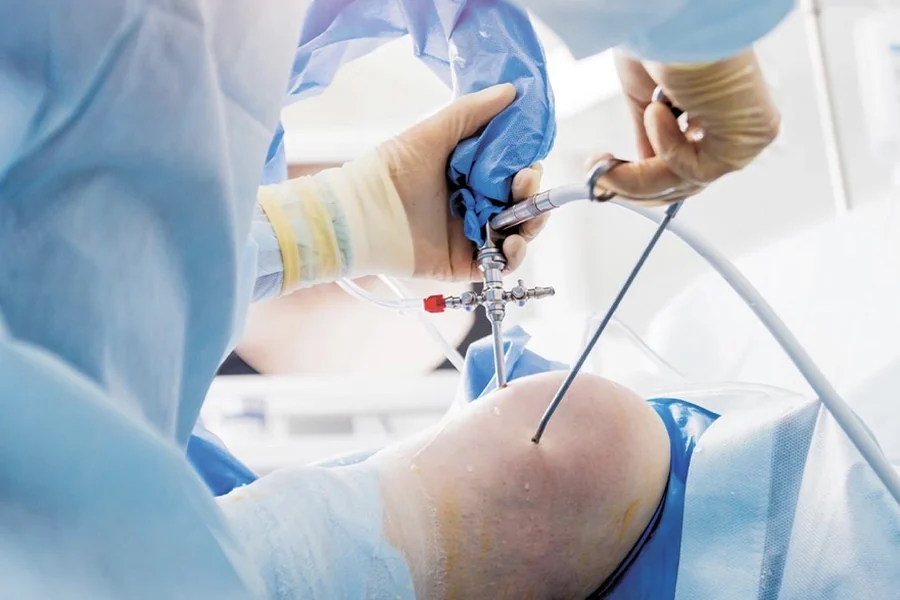
Knee arthroscopy
Keyhole knee surgery — a camera and fine instruments through two small incisions — for meniscus tears, ACL reconstruction, loose fragments and damaged cartilage.
Read more
Joint injections
Targeted injections used to settle inflammation and pain in a specific joint or tendon, usually to make rehabilitation possible.
Read more
Non-surgical arthritis care
A structured plan to control arthritis pain and keep you active — for the many patients who do not need surgery, or who are not ready for it.
Read moreConsidering robotic knee replacement?
Bring your X-rays or MRI if you have them. A consultation should leave you clear about what is wrong, what the options are, and what happens if you wait.