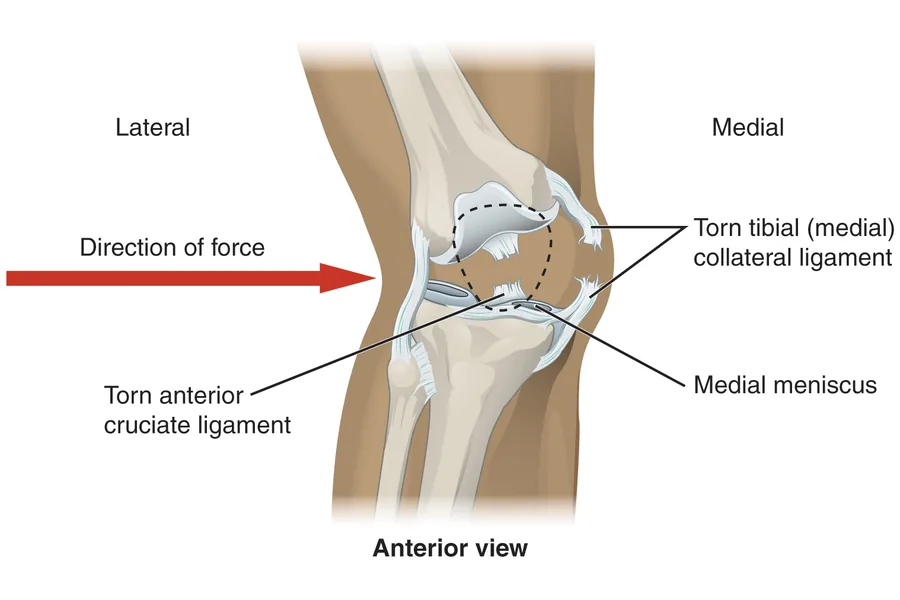
A footballer plants a foot and turns; a cricketer slips while fielding; someone steps awkwardly off a kerb. The knee twists, it hurts, and a day later it is swollen. Three structures are most often injured this way — the anterior cruciate ligament (ACL), a meniscus and the medial collateral ligament (MCL) — sometimes alone, often together. They feel different, and they are treated very differently.
ACL tear: a pop, fast swelling, and a knee you cannot trust
The ACL sits in the middle of the knee and controls twisting. When it tears, many people feel or hear a pop and cannot carry on playing. The knee swells within a few hours, because the ligament bleeds into the joint. After a couple of weeks the swelling settles and walking in a straight line may feel almost normal — but the knee gives way when you turn, step sideways or land from a jump.
A completely torn ACL does not heal back. Whether it needs reconstruction depends on how unstable the knee is and what you want to do with it; people who want to return to pivoting sport usually need surgery.
Meniscus tear: joint-line pain, catching and locking
Each knee has two menisci, C-shaped pads of cartilage that cushion the joint. A twist can trap and tear one. The pain is usually along the inner or outer joint line, the swelling comes on more slowly — over a day rather than a few hours — and the knee may catch, click or lock so that it will not straighten fully.
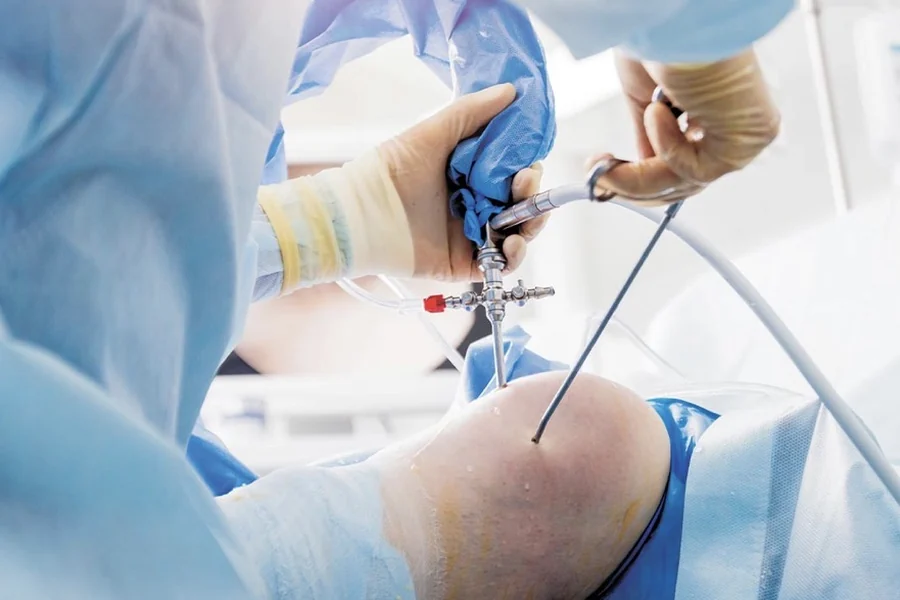
Many meniscus tears settle with physiotherapy. A knee that is truly locked, or a tear in a younger knee that can be repaired, is a reason for keyhole surgery; repairing a meniscus rather than trimming it protects the joint for decades.
MCL sprain: pain on the inner side
The MCL runs down the inner side of the knee and stops it bending inwards. It is injured by a blow to the outer side of the knee, or a twist that forces the knee inwards. The pain and tenderness are along the inner side, there is usually less swelling inside the joint, and the knee may feel unstable when pushed sideways rather than when turning.
The MCL has a good blood supply and usually heals without surgery: a hinged brace and physiotherapy for a few weeks for a sprain, and up to about three months for a complete tear.
Side by side
- A pop, swelling within a few hours, and a knee that later gives way when turning: think ACL.
- Pain on the joint line, catching or locking, and swelling over a day: think meniscus.
- Pain and tenderness on the inner side after a blow or an inward twist: think MCL.
- More than one of these: common after a bad twisting injury, and a reason for an early specialist assessment.
What to do in the first two weeks
- Stop playing. Carrying on through a twisting injury is how one tear becomes several.
- For the first 48 hours: rest, ice over a cloth, a compression bandage and the leg raised; crutches if it hurts to walk.
- Start gentle bending and thigh-muscle tightening early, so the knee does not stiffen.
- Have the knee examined if it swelled quickly, locks, gives way, or is not clearly improving after a week or two.
How the diagnosis is made
A careful examination tells these injuries apart more often than people expect: specific tests check how well the ACL controls the shin bone, stress the MCL, and load the meniscus along the joint line. An X-ray rules out a fracture. An MRI confirms what is torn and, importantly, shows combinations — an ACL tear with a meniscus tear changes both the timing and the plan.
Sports and ligament injuries at Poona Orthopaedic Clinic are seen by Dr. Atul Keswani. If you are not sure what you have done to your knee, an assessment in the first few weeks makes the rest of the recovery simpler.