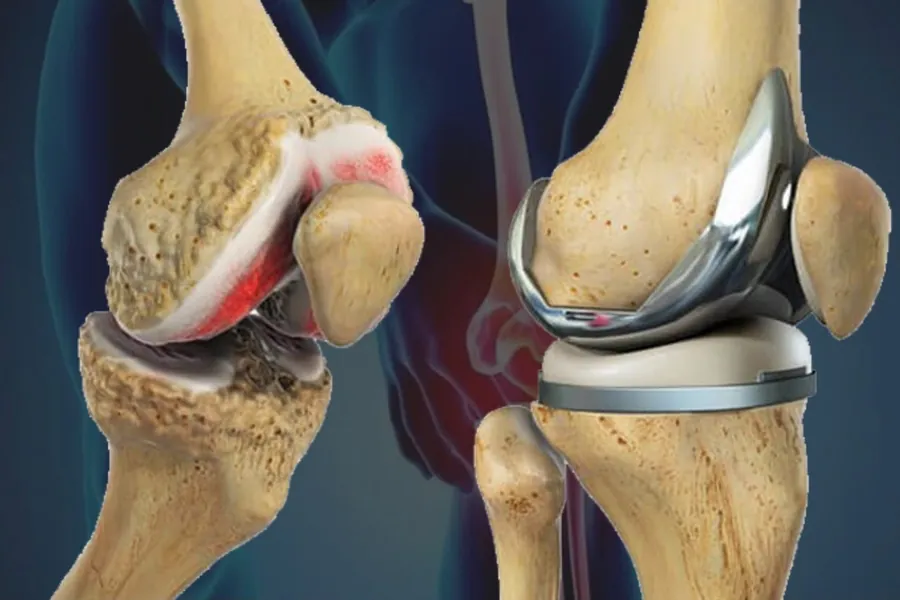
Ask three hospitals in Pune what a knee replacement costs and you may get three quite different numbers. That is rarely because one of them is overcharging: the quotes usually differ in what they include. Knowing what makes up the total is the best way to compare them, and to avoid surprises at discharge.
What it costs at Poona Orthopaedic Clinic
Knee replacement at the clinic costs ₹1.4 lakh plus the cost of the implant. The implant is priced separately because the right design depends on your knee, and its brand and price are shown as a separate line on your estimate. The rest of this guide explains what can change the total and what to check with your insurer.
What goes into the total
- The implant — the metal and plastic parts of the new knee. Its price depends on the material and design. Since 2017 the government’s National Pharmaceutical Pricing Authority (NPPA) has set ceiling prices for knee implants and has renewed them year by year; ask for the implant’s brand and price to be shown separately on your estimate.
- The operation — the surgeon’s, assistant’s and anaesthetist’s fees, and the operating theatre.
- Robotic assistance, if used — the planning and the robotic system usually add a separate charge.
- The hospital stay — the room category and the number of nights, typically three to five for one knee.
- Tests and medicines — blood tests, ECG and X-rays before surgery, and medicines and dressings during the stay.
- Physiotherapy in hospital — the first sessions, which begin the day after surgery or sooner.
What usually changes the number
- One knee or both. Replacing both knees together costs less than two separate operations, but more than one.
- Robotic or conventional. Robotic-assisted surgery carries an additional charge, and insurers differ on whether they cover it.
- Room category. A general ward, a twin-sharing room and a private room are charged differently — and with insurance, the room can affect more than the room rent (see below).
- Your general health. Diabetes, heart or kidney conditions can mean extra tests, a longer stay or time in a high-dependency unit.
- The implant. Most knees do well with a standard implant; special designs are needed only in particular situations.
What is often not included
- Physiotherapy after discharge, at home or at a centre, usually for six to twelve weeks
- A walker, a raised toilet seat or other equipment for home
- Medicines after discharge, follow-up X-rays and follow-up consultations
- Treatment of a complication, which is uncommon but possible
Insurance and cashless treatment
Most health insurance policies cover knee replacement when it is needed for arthritis. For cashless treatment, the hospital’s insurance desk sends a pre-authorisation request to your insurer or TPA with the surgeon’s notes and the estimate, usually a few days before admission. Three parts of your policy are worth checking early:
- Waiting periods. Many policies do not cover joint replacement, or a pre-existing condition such as arthritis, until the policy has been held for a set period — commonly two to three years.
- Room-rent limits. If your policy caps the room rent and you choose a more expensive room, many insurers reduce the payout on other parts of the bill in proportion, not only the room. Staying within your limit can make a large difference to what you pay yourself.
- Co-payment and sub-limits. Some policies, particularly for older people, pay only a percentage of the bill, or set a ceiling for specific operations.
Employer and government schemes have their own lists of approved hospitals and package rates; check that the hospital is on your scheme’s list before you fix a date.
Questions to ask before you agree an estimate
- Is this estimate for one knee or both, and for robotic or conventional surgery?
- Which implant is included, and what is its price?
- How many nights, and which room category, does it assume?
- What is not included — physiotherapy after discharge, medicines, follow-up visits?
- What happens to the cost if I need an extra day in hospital?
- How much will my insurance pay, given my room-rent limit and any co-payment?
How the clinic gives an estimate
An estimate only means something once the surgeon has examined you, seen your X-rays and decided with you whether you need surgery at all — many painful knees do not. After a consultation at Poona Orthopaedic Clinic in Kondhwa you are given a written estimate for surgery at the hospital agreed with you, setting out what it includes, and the hospital’s insurance desk can check it against your policy before you decide.